Showing posts with label korean food. Show all posts


Main Ingredients:

  • 3 yellow croaker fish 
  • 2 cups korean radish (10 oz)
  • 1/2 onion
  • 2 green onions
  • 1 hot pepper (optional)

Broth Ingredients:
  • 4 cups water
  • 1 dried anchovy pack (6 dried anchovies)
  • 5 pieces kelp (1 x 2 inch)

Seasoning Ingredients:
  • 2 tbsp soup soy sauce
  • 1 1/2 tbsp hot pepper oil
  • 1 tbsp red pepper powder
  • 1 tbsp cooking wine
  • 1 tbsp minced garlic
  • 1/4 tsp minced ginger

Steps:
  1. To make the broth, start with 4 cups of water, and then add 1 dried anchovy pack and 5 pieces of kelp. Boil it on medium-high for 5 minutes.

  2. After rinsing 3 yellow croakers, cut the tail and fins with scissors.

  3. 5 minutes later, remove the kelp from the broth, and boil for 5 more minutes.
  4. Meanwhile prepare the vegetables. Peel off the radish skin and remove the bad parts. Cut it into 1 x 2 x 1/2 inch pieces.
  5. Slice 1/2 of an onion into 1/2 inch pieces.
  6. Cut 2 green onions into 1/2 inch pieces.
  7. Cut 1 hot pepper into 1/2 inch pieces. The pepper is optional.
  8. After the boiling is finished, remove the anchovy pack.

  9. Add all of the ingredients for the seasoning to the broth. 2 tbsp of soup soy sauce, 1 1/2 tbsp of hot pepper oil, 1 tbsp of red pepper powder, 1 tbsp of cooking wine, 1 tbsp of minced garlic, and 1/4 tsp of minced ginger.

  10. Then add the radish and cook for several minutes with lid on it until it starts to boil again.
  11. Add the fish and onions.
  12. Cover the lid and cook for about 10 minutes on high. In this step, if you like spicy food, add 1 tbsp of red pepper powder. Adjust the saltiness if you want.

  13. About 10 minutes later, add the chopped green onions and hot peppers into the soup. Cook 2 more minutes on high and then turn off the heat. Be careful because it is easy to add too much pepper in the soup.


Main Ingredients:

  • 1 pack soft tofu (14 oz)
  • 2 cups milk
  • 3 tbsp roasted unsalted peanuts (1 oz)
  • 1/4 cup sliced almonds (1 oz)
  • 2 tbsp sugar (optional)
  • 1/2 tsp salt
  • some cucumber (garnish)
  • some cherry tomatoes (garnish)
  • some black sesame seeds (garnish)

Noodles Ingredients:
  • 8 oz thin noodles
  • 12 cups water
  • 1 tsp salt

Steps:
  1. Obtain 1 pack of soft tofu. You can use the type of tofu you like.
  2. Cook the tofu in  boiling water for about 30 seconds.

  3. Obtain 3 tbsp of roasted, unsalted peanuts and 1/4 cup of sliced almonds. Depending what you have or what your flavor, you can use different kind of nut such as: walnuts, pine nuts, cashews and etc. Just obtain about 1/2 cup worth of the nut that you pick. If you use walnuts, soak them in water for sometime and remove the skins.

  4. Add the tofu, and 2 cups of milk in a blender.

  5. Grind for about a minute, or until you have well blended soybean milk.
  6. Pour the soup into a large mixing bowl and add 2 tbsp of sugar and 1/2 tsp of salt. Mix until the sugar and salt dissolves. You may want to adjust the sweetness or saltiness. 

  7. Cover the container and chill it in the refrigerator for an hour or more before serving.
  8. When it is time to serve this food, julienne some cucumber and cut some cherry tomatoes in half for garnish. 
  9. Obtain about 8 oz of thin noodles.
  10. Add the thin noodles in about 12 cups of boiling water with 1 tsp of salt and cook them for about 4-5 minutes.

  11. Rinse the cooked noodles in cold water several times and drain.

  12. Put some of the noodles, cucumber and tomatoes in serving bowl.

  13. Pour some of the soup on top of the noodles. If you want extra cold noodles, add some ice.
  14. Sprinkle some black sesame seeds on top for garnish if you have them.


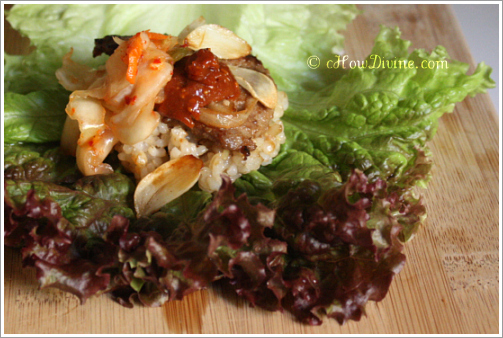
Ssam Recipe
Ingredients
red leaf lettuce leaves
steamed brown or white rice
bulgogi
garlic cloves, sliced lengthwise
baechu (cabbage) kimchi
ssamjang
  1. Cook bulgogi according to recipe.
  2. Coat the bottom of a pan with canola or other cooking oil. Add sliced garlic to the pan. Heat the pan on medium heat. Once the garlic slices turn golden brown on the bottom-side, turn with tongs or chopsticks to finish cooking on the other side. (Once the pan heats up, it should take about a minute.) Remove from heat.
  3. Assemble the ssam by first adding a spoonful of steamed rice to the lettuce. Add bulgogi, slice of grilled garlic, piece of kimchi, and a dollop of ssamjang to the rice.
  4. “Wrap” by pulling up on the edges, in the shape of a drawstring purse. Put the whole ssam in your mouth! That’s the way the Koreans do it. Enjoy!

With increase in commodity prices reflected on the shelves of your favorite grocery outlet, Ramen still remains one of the most economical ways to satisfy your hunger pain. With its starchy, salty, brothy, and piping hot noodles, it meets all the criteria as an ultimate comfort food, especially late at night. We have all done it. What’s great about cooking Ramen is everybody has their own recipe, you can add protein, leftover veggies, cheese, in our case, Korean Dduk (sliced rice cake, 떡). We love Ramen because it provides us with all the comfort compounds in a small package. Ramen is best eaten quickly, before it gets soggy in the hot broth; make that slurping noise to cool it down. So make noise, don’t be shy, and cook Ramen!


Korean Food:비빔밥 Bibimbap


Bibimbap is a dish mixed of cooked white rice, vegetables, beef, garnishes and fried red pepper paste. It is said that this dish came from the customs of memorial services and rural villages. This dish is very easy to prepare, just mixing together cooked white rice with various vegetables, namul and red pepper paste. 

You can purchase the material from us if you want to prepare this food for your family members~ We will provide you the fresh and best quality cooking material~ ;)


Have you ever try 도시락!?This will bring back the memories of Korean while they shake hardly to make their best Lunchies!
Don't forget to have a try!


Heart Shape Fried Egg (하트 모양 계란말이)

Main Ingredients
4 Large Eggs
1 Tbsp Green Onion
½ Tbsp Carrot
¼ tsp Salt
Some Oil

Danmuji
Danmuji - strips colored with chija (Gardenia) in the back and half-circles colored with turmeric
Danmuji (단무지) literally means sweet radish pickle, originated in Japan and instantly recognized by its bright yellow color.  It's a must-ingredient for kimbap (김밥; rice rolls wrapped in seaweed), and an equally important accompaniment for jajangmyeon (짜장면; noodles with black bean sauce).  Its sweet, tangy, bright flavor along with refreshingly crunch bites delivered at a cheap cost make danmuji a favorite side dish in bunsik (분식; snack) places in Korea. 
Although it's common to buy danmuji in packages at a grocery store, it is also as easy to make at home.  The home version danmuji can be made by quick pickling, which requires pouring the boiled pickling liquid over the main ingredient, in this case, daikon radish.
While it doesn't have to be bright yellow, the color is part of its identity many people associate danmuji with.  You may be lucky enough to get dried chija (치자; Gardenia jasminoides) from your area, which is dried gardenia fruit traditionally used for natural coloring as well as herbal medicine in Korea.  Chija starts releasing its orange-yellow color immediately as it comes into contact with water.  It'll get you the color fitted for danmuji along with slightly fragrant, earthy note in the background. 
A more accessible option is adding a small amount of turmeric from your spice rack for the bright yellow color in danmuji.  A hint of this exotic spice that comes through in danmuji is pleasantly refreshing. 
Now that we've settled on getting the proper yellow color for danmuji, try this recipe at home.  The recipe is adjustable, of course, depending on the amount of radish and your preference for sweetness.  Just make sure the liquid is enough to cover the radish.  Enjoy~!  
Daikon Radish Danmuji - turmeric
(L) Use a firm daikon radish with tight, smooth surface inside, i.e., free of any holes. (R) in turmeric pickling liquid
Chija Danmuji - chija
Chija (치자) makes a great coloring agent for danmuji. 

1 small daikon (Japanese radish), about 2 cups, peeled
1/2 C rice vinegar
1/2 C water
1 TBSP sugar
1/4 ts salt
1 ts turmeric powder or 3-5 pieces of dried chija (치자; Gardenia jasminoides)
Optional) 1/2 ts black peppercorns
If you're making this as a convenient side dish, cut daikon into thin slices then cut in half.  If you're using this mainly for a kimbap ingredient, cut in long strips.
Mix together rice vinegar, water, sugar, turmeric (or chija), and black peppercorns.  Bring the liquid up to a boil, then pour it over daikon slices.
Cool danmuji to room temperature, then place it in an airtight container.  If you want to expedite its pickling, leave it out at room temperature overnight.  It should be ready to eat the next day.  Store danmuji in the refrigerator.  The color will continue to deepen for the next few days.

Cr: http://www.shinshine.com/my-blog/2011/11/danmuji.html

In Korean cuisine, glass noodles are usually made from sweet potato starch and are called dangmyeon (Hangul: 당면; Hanja: 唐麵; literally "Tang noodles"; also spelled dang myun, dangmyun, tang myun, or tangmyun).
They are commonly stir-fried in sesame oil with beef and vegetables, and flavored with soy and sugar, in a popular dish called japchae (hangul: 잡채). They are usually thick, and are a brownish-gray color when in their uncooked form.

 
Ingredients:
1/2 lb sweet potato noodles (dangmyeon)
1/4 cups sugar
1/3 cup soy sauce
1 tbsp sesame oil
3 cloves of minced garlic
1 carrot thinly sliced into matchsticks
1/2 red bell pepper, sliced
3 stalks green onion chopped into 3-inch lengths
1/2 yellow onion, sliced
1/2 cup shitake mushrooms, sliced
1/2 pound bulgogi
1 bunch spinach

Directions:
In small bowl combine sugar soy sauce, sesame oil, mix and set aside. Take a medium saucepan, fill with water and boil. Add spinach to the boiling water, blanch and quickly drain. Squeeze out excess water with your hands. Set aside. Boil another pot of water, add the sweet potato noodles and cook 3-5 minutes until soft. Drain and set aside.

Take a large skillet, place on the stove and add 1 tbsp oil. Heat on medium heat and add garlic to simmer for a minute. Add all vegetables and stir-fry until they start to soften. Add spinach and noodles and stir. Then add soy sauce mixture to cott. Finally add bulgogi, stir-fry everything and serve hot or cold! :P
2

For 4- 6 servings.
Ingredients:
Recipe:
Arrange everything on a platter.
  1. Cook rice. You can use a rice cooker or a stainless pot.
  2. Next, you need to prepare a large platter to put all your ingredients on. Rinse your bean sprouts 3 times and put them in a pot with a cup of water. Add 1 ts of salt and cook for 20 minutes. Drain water and mix it with 1 clove of minced garlic, sesame oil and a pinch of salt.
    Put it on the platter.
  3. Put your spinach in a pot of boiling water and stir it for a minute. Then rinse it in cold water a few times and squeeze it lightly. Mix it with a pinch of salt, 1 ts of soy sauce, 1 clove of minced garlic and sesame oil. Put it on the platter
  4. Cut 2 small size zucchinis into thin strips, sprinkle them with a pinch of salt, and then mix them together. A few minutes later, sauté them in a pan over high heat. When it’s cooked, it will look a little translucent. Put it on the platter.
  5. You can buy soaked and cooked “kosari” at a Korean grocery store. Prepare about 2 or 3 cups of kosari for this 4 servings of bibimbap. Cut it into pieces 5-7 cm long and sauté in a heated pan with 1 ts of vegetable oil. Stir and add 1 tbs of soy sauce, 1/2 tbs of sugar, and cook them for 1-2 minutes. Add sesame oil. Put it on the platter.
  6. Slice shitake mushrooms thinly and sauté with 1 ts of vegetable oil. Add 2 ts of soy sauce and 1 or 2 ts of sugar and stir it for 2 minutes. Add some sesame oil, and put it on the platter.
  7. On a heated pan, put some oil and 200 grams of ground beef and stir it. Add 4 cloves of minced garlic, 1 tbs of soy sauce, 1/2  tbs of sugar, a little grounded black pepper, and sesame oil. 
    Put it on the platter
    .
  8. Cut a carrot into strips, sauté it for 30 seconds and put it on the platter.
  9. prepare eggs with sunny side up.
  10. Put your rice In a big bowl, and attractively display all your vegetables and meat t. Place the sunny side up egg on the center.
  11. Serve it with sesame oil and hot pepper paste.
  12. Lastly, mix it up and eat!
bibimbapnamul
You could use any of your favorite ingredients to make delicious bibimbap:  carrot, fernbrake (kosari), spinach, white mushrooms, zucchini, soybean sprouts, salmon, okra, and red bell pepper
*For those who can’t tolerate spicy sauce. : )
Yangnyeomjang sauce:
Chop 4 green onions and put them in a small bowl. Pour half cup of soy sauce in there, and add 1 tbs of sesame seeds, 2 ts of sugar, 1 tbs of sesame oil and mix it up.
Egg soup:
  1. Put a can of chicken broth in a pot, as well as 2 cans of water using the can from the chicken broth. Boil it.
  2. Beat 2 eggs with a fork and pour it into the boiling stock while stirring slowly. Put some salt in it if you want.
  3. Chop 2 green onions
  4. Serve your soup in a small bowl and sprinkle some chopped green onion over the top.


south korean food1 South Korean Food: 29 of the Best Tasting Dishes
Mixed Cold Noodles (Bibim Naengmyeon 비빔 냉면) - South Korean Food

Mixed Cold Noodles (Bibim Naengmyeon 비빔 냉면)

Though every bite made me colder, I highly enjoyed this bowl of kimchi flavored bibim naengmyeon. The noodles were thin and chewy, topped with slices of cucumber, cabbage, a hard boiled egg, and a slosh of sour kimchi flavored ice.
It was like a kimchi popsicle and it was delicious!
Copyright © 2012 KOREAN KIM'S MART